Why Mental Health of our Hogs Matter

ES101717.jpg

Today I felt impressed to share with you a little about HOW the mental health of our hogs affects your meat.

There is energy in everything around us. A ray of light, a flower, a field of green grass. A positive thought, a negative thought.

Energy is transferable.

When you read a disturbing headline or hear some bad news it will effect your energy and your mood.

Think for a minute if you watched a really inspirational movie and afterwards you are are on cloud 9, feeling inspired and moved.

You were energetically impacted by that movie.

Lets translate that to the food you consume.

It holds energy too.

A fresh green bean from the garden or farmer’s market has more life energy than a can of green beans off a shelf.

A pork chop from a hog raised indoors, under artificial lights, crowded with it’s siblings, all screeching and squealing at mealtime will have a different energy than a hog raised in an oak forest.

It only makes sense that if the animal you are eating lived a traumatic life that can transfer to you, either in taste or actual energy.


The mental health of our hogs matter.


To you, to us, to them.


Both Blake and I come from careers in animal behavior and psychology. I studied natural horsemanship and taught my students to read their horses subtle body language. I taught them how to read the ears, eyes, tail, breathing, and sweat patterns of their horses.

Blake came from a career of Wildlife Biology. Also heavy in studying wildlife behavior and patterns. There is a certain savvy that comes from being a student of animals and studying their behavior, living amongst them, and working with them.

I'm sure you have that level of understanding in your area of expertise too.

Just the other day, as we were talking about how natural our pigs live, what a good life they have, and how contrary it is to how grocery store pork is raised, he told me this story:

When he was a young man he was volunteering at a zoo in Germany. His task for the day was to fill in a trench 12" wide in the bears pen. The bear had worn this ditch along the fenceline of his enclosure by pacing back and forth. He remembers that the bear would walk down to one end, stand up on its haunches and pivot the other direction and walk to the other end. Back and forth all day long until it wore a path. That bear was not in a good space mentally. The artificial environment, although humans thought it was pretty and clean, was not what the animal needed.

Pigs who live in confinement have similar displaced behaviors. Things like chewing on the tails of other pigs, excessive squealing, chewing on the bars, frothing at the mouth, climbing over pen walls.

8981CA7B-781E-4A71-B35B-76E8E3C0A622-448-000000769CB0A027.jpg

So the solution in that world is clipping teeth, docking tails, building bars that go over the tops of pens and wearing protective ear muffs when they go into the pig barns.

Confinement hogs also live on metal or plastic slats so the manure can be washed through. Their sewage sits in a lagoon underneath them. The odor of any confinement farm is often a big complaint of neighbors, not to mention unpleasant for the hogs.

Blake remembers how noisy it was in the pig barn at feeding time growing up 30 years ago. His dad had 500 pigs at one point, raised conventionally indoors. It was an ear piercing squeal that put you on edge, and is probably part of the reason he is hard of hearing.

ES101656.jpg

Not here on our farm.

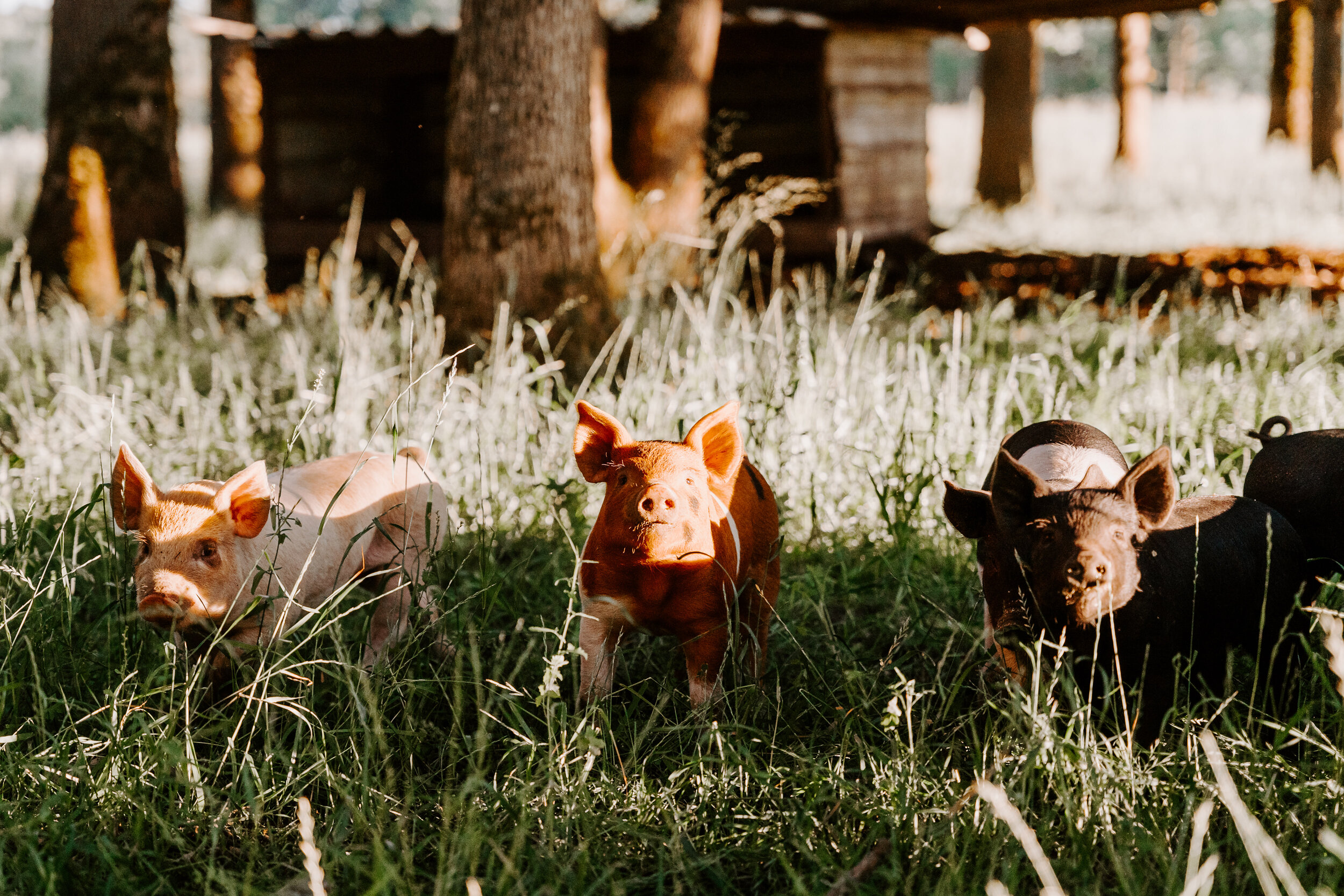
Our pigs live in a 5 acre oak grove, in the fresh open air. They enjoy the natural rhythms of sunlight and darkness.

They have logs to turn over, grasses to munch, grubs to dig for, acorns to discover and lots of room to move about.

They live on the dirt, they may even eat the dirt to build their immunity. If they find a patch of clay or charcoal they might eat that too.

They don't need antibiotics, and to catch wind of their poo you have to basically be standing overtop a pile.


I know I'm preaching to the choir here, you already have found our farm, but your work is in telling others why you buy from us rather than the cheap meat at Costco or Safeway.

Your contribution can be in sharing the difference between conventional animal farming at the expense of the animal’s well being and what we do.

Please send this blog to a friend who wants to be tuned in energetically to their food.

I’m curious, had you ever thought about energy transferring to you through the food you eat?
ES101525.jpg

What You Get With 1/4 Beef

beef chalk.png

Buying in bulk can be daunting but I promise you the benefits outweigh the risks. I am here to walk you thorough the process, explain what comes with 1/4 beef, and how it saves you money.

You will love the convenience and peace of mind that comes along with having your own 1/4 beef in your freezer.

A quarter is not the only bulk beef you can buy though! It comes in eighths, halves and wholes also.

So let me explain the differences:

Quarters:

  • A quarter beef is recommended for families with 1-2 adults and small children, as long as you also eat other proteins like chicken, pork, lamb, eggs, otherwise you may need a half.

  • Will easily fit into a 5-7 cubic foot chest freezer or would take up a quarter of small upright freezer.

  • Includes a variety of steaks, roasts, ground beef, organ meat and bones.

  • Customizable with how thick you want your steaks, how many per package and roast package size.

  • Hanging weight of a quarter ranges between 125-200 pounds, and packaged weight ranges between 90-150 pounds. If you need clarification on the different weights read this: 3 Types of Weights

  • You save about $100 buying a quarter verses buying the individual cuts that would come in a quarter. You end up paying about $9/lb for all the cuts across the board, which is the price of our least expensive cut: ground beef. So you are getting the prime cuts like New York Steaks or Ribeye Steaks, which are normally valued at $23-$25/lb for ground beef price, $9/lb.

Here are the typical cuts that come in a quarter beef:

(4-6) Ribeye Steaks

(1-2) Tenderloin Steaks

(2-4) T-Bone Steaks (or New York Steaks + Tenderloin)

(1-2) Sirloin Tip Steaks

(2-3) Top Sirloin Steaks

(1-2) Cross Rib Roasts

(2-3) Top Round Roasts

(4-5) Chuck Roasts

(1-2) Short Ribs

(1-2) bags of broth bones

(40-50) Ground Beef

(2-3) Osso Bucco (aka Beef Shanks)

(1-2) packages liver


Halves:

  • Buying a half you save about $200. You end up paying about $9/lb for all the cuts across the board, which is the price of our least expensive cut-ground beef. So you are getting the prime cuts like New York, Tenderloin and Ribeye Steaks, which are normally valued at $23-$30/lb for ground beef price, $9/lb.

  • Recommended for families with 2 adults and 2+ middle school or high school age kids. Also great for families who do not eat other meats such as pork, lamb or chicken.

  • With a half beef you double all the cuts above plus:

(1-2) Brisket

(1) Flank Steak

(1) Tri Tip Roast

(2) Skirt Steaks

(1-2) Beef Cheeks

(1-2 lbs) Heart

(1-2) Kidney


Wholes:

  • For large families with 2-4 adults and 2+ teenage kids with big appetites. Great for multigeneration families living together. A lot of families even split up a whole beef when they aren’t living together. The price per pound hanging weight does drop for halves and wholes. And you save about $400 buying a whole beef verses buying individual cuts.

  • The only way to get an oxtail is to order a whole beef, sorry friends, there is only one of those per animal!

  • Plan on 16-17 cubic feet of freezer space for a whole beef. This would be an entire upright freezer or a medium sized chest freezer.


Eighths:

  • An eighth is a few steaks, a couple roasts and mostly ground beef. You save about $50 buying this way.

  • It’s a great sampling of our meats if you’ve never bought in bulk before. Good for single adults or households with 2 adults, or even one adult and one small child.

  • An eighth beef can fit in the top freezer portion of a fridge/freezer combo with room left over. It needs about 3 cubic feet.

  • Here’s what comes typically in an eighth:

(1) Sirloin Tip Steak

(1) New York Steak

(1) Tenderloin Steak

(2) Ribeye Steaks

(12-15) Ground Beef

(3-4) Stew Meat

(1) Chuck Roast

(1) Sirloin Tip Roast

(1) Broth Bones

(1-2) Osso Bucco

Hopefully this helps give you an idea of what comes with an eighth, quarter, half or whole beef.

Our premium Grass Fed and Finished Beef will be so nice to have at home in your freezer. Less trips to the grocery store, more peace of mind knowing your stocked up for the year.

When you buy in bulk you save money and time, you’re not picking up a piece here and there but the once a year purchase has you covered.

How it works is you first put down a deposit for the quantity of beef you want. You will be put on our waitlist for the next available butcher date, so the sooner you want your beef, the sooner you should reserve it.

Thanks for supporting our family farm and for valuing your health enough to eat Grass Fed meats!

3 Types of Weights: Live, Hanging and Packaged

beef cuts.jpg

Often times when you are getting ready to buy in bulk with a half, quarter or eighth beef the question comes up “what is the hanging weight, and why is it different than what I take home?”

It’s easy to get confused about the difference between hanging weight and packaged weight, so I thought I would clear that up.

When we sell in bulk the measurement we use to calculate cost is hanging weight, but there are actually 3 types of weights to be aware of: live weight, hanging weight and packaged weight.


Live Weight is how much the cow, pig or lamb weighs when it’s alive, on the hoof. Similar to how we weight ourselves, it’s pretty straight forward.


Hanging Weight is a weight the butcher gives us after the animal has been killed, blood drained, head, hide, feet, entrails & organs removed. The hanging weight is usually about 60% of the live weight. So if a cow weighs 1000 lbs live weight its hanging weight will be 600 lbs. A half share would be 300 lbs, a quarter would be 150 lbs and an eighth would be 75 lbs (approximately). This is also the weight the butcher uses to charge us for cutting/wrapping fees. When you buy in bulk we cover all the standard butchering fees in the you pay us. The hanging weight is the most consistent way to measure the carcass before getting into customizing the cuts.


Packaged Weight or sometimes referred to as Final Weight or Take Home Weight is how much you, the customer, take home after it has been packaged. This is usually 60-65% of the hanging weight. The loss comes from 2 places: `water loss and bone loss. Water loss occurs during the dry aging process where the beef is allowed to hang for 10-14 days to tenderize. The second place you might loose weight is from cutting the meat off the bones. So the more boneless cuts the customer requests the less the packaged weight will be. It’s important to point out that lower weight doesn’t mean you are receiving less meat, but rather than you are receiving fewer bones. If you request marrow or knuckle bones for making broth you retain some of this weight.


This is a guide to go by, but always an approximation. The weights vary between individual animals and butchering style. While we try to use the same butcher to stay consistent, we occasionally use other butchers who offer a variety of cuts and more timely butchering appointments.

Hopefully this information was helpful if you’re considering buying a beef share. As always, reach out if you have any questions!

Simple Tuscan Soup

This recipe comes together quickly for a homemade weeknight meal that you don’t have to spend hours making.

It uses Nourished With Nature Pastured Pork + homemade chicken broth and a few other fresh ingredients that make it hardy, warm, nutrient dense and customizable to your diet preferences.

Serves 4, double it for lunch leftovers!


INGREDIENTS:

  • 1 lb Nourished With Nature Italian or Fresh Ground Pork Sausage

  • 1 Tbsp Nourished With Nature Pork Lard

  • 1 large onion (or 3 small if they are homegrown)

  • 1 head of garlic (or 8 cloves) pressed or diced

  • 2 Tbsp dried Italian Herbs (oregano, thyme, rosemary)

  • 4 medium size russet potatoes (can substitute cauliflower), peeled and diced into 1” chunks

  • 2 Quarts Chicken Broth made from Nourished With Nature pastured chickens (about 8 cups)

  • 1 bunch of fresh spinach (kale or chard also work), washed and chopped


INSTRUCTIONS:

  1. Over medium to high heat cook pork sausage with lard in large stock pot, browning then crumbling until it’s cooked all the way through.

  2. Add in onion and cook 1-2 minutes until translucent

  3. Add in garlic and dried herbs and cook until you can smell the garlic becoming fragrant

  4. Add in diced potatoes

  5. Add in broth and simmer until potatoes are cooked through (about 10 min)

  6. Turn off heat and add in chopped spinach, allowing to wilt

  7. Serve up into bowls and enjoy!

Cook pork sausage in a large stock pot over medium high heat, browning and crumbling

Cook pork sausage in a large stock pot over medium high heat, browning and crumbling

Dice up onion, garlic and herbs and add into sausage.

Dice up onion, garlic and herbs and add into sausage.

Cook onions and garlic with sausage until translucent and fragrant.

Cook onions and garlic with sausage until translucent and fragrant.

Add in your diced potatoes.

Add in your diced potatoes.

Add in chicken broth and simmer until potatoes are cooked through.  Turn off heat, add in spinach.

Add in chicken broth and simmer until potatoes are cooked through. Turn off heat, add in spinach.

Enjoy with a slice of crusty artisan bread or a side salad!

Enjoy with a slice of crusty artisan bread or a side salad!

What substitutions are you going to make?

Are you eating Paleo, following the Carnivore diet or eating gluten free?

Cider Brined Pork Chops with Maple-Bacon Chutney

Sweet Maple Bacon on top a moist Pork Chop…why not?!

This recipe combines two of my favorite cuts of pork and is fancy enough for a 5-star restaurant.

Perfect for a Valentine’s Dinner for 2 at home!

Here are the supplies you’ll need:

INGREDIENTS:

IMG_5872.JPEG
  • 4 Nourished With Nature Pork Chops

For the cider brine:

  • 3 quarts cold water

  • 1 quart apple cider

  • 1/2 cup apple cider vinegar

  • 1 1/4 cup salt (I like Redmond Sea Salt)

  • 3/4 cup Agave (can substitute honey or sugar)

For the maple-bacon chutney:

IMG_5876.JPEG
  • 1 lb Nourished With Nature Bacon ends, diced

  • 1 small onion, diced

  • 3 cloves garlic, minced

  • 1 cup maple syrup

  • 1 Tbsp black pepper, coarsely ground

  • 1 Tbsp mustard powder

  • 2 cups apple cider

  • 1 bay leaf

  • salt to taste

INSTRUCTIONS:

  1. Add all the ingredients for the brine together.

  2. Add the pork chops to the brine in a 9x13 glass dish with a lid or plastic bag, and let brine in the fridge for 12-18 hours.

  3. In a medium saucepan sauté the bacon until half cooked. Drain off the rendered fat, add the onions, garlic and sauté until translucent.

  4. Add remaining ingredients and simmer until thick and syrupy. Remove bay leaf and salt to taste.

  5. Drain pork chops from the brine, rinse and pat dry before grilling.

  6. Place pork chops on medium to high heat, flip after 5-7 minutes when nice brown crispy bits begin to form. Internal temp should be at 160 deg F.

  7. Top with warm maple-bacon chutney.

  8. Enjoy!

Order your bacon and pork chops online then swing by the farm store to pick up at your convenience.

You can also choose to pick up at the farmer’s markets each week, just check our website for when and where.

Recipe adapted from Food Republic and Chef Rick Gresh

Recipe adapted from Food Republic and Chef Rick Gresh